12 November, 2013
2013: THE YEAR OF JESS FRANCO

11 November, 2013
DIE MARQUISE VON SADE-DORIANA GREY Blu-ray
Rock! Shock! Pop! - Die Marquise Von Sade (The 1000 Shades Of Doriana Grey)
Here's a link to a review of the new Ascot Elite Blu-ray of Die Marquise Von Sade/Das Bildnis der Doriana Gray. I have the previous Elite DVD, which looks fine, but I'm particularly interested in seeing the shorter softcore alternate version contained as an Extra on this presentation. It's one of Jess Franco's most artistically accomplished films with stunning cinematography, an Ingmar Bergman tone and Lina Romay delivering a moving, memorable performance.

Here's a link to a review of the new Ascot Elite Blu-ray of Die Marquise Von Sade/Das Bildnis der Doriana Gray. I have the previous Elite DVD, which looks fine, but I'm particularly interested in seeing the shorter softcore alternate version contained as an Extra on this presentation. It's one of Jess Franco's most artistically accomplished films with stunning cinematography, an Ingmar Bergman tone and Lina Romay delivering a moving, memorable performance.
09 November, 2013
IN SEARCH OF A DVD/R - CRYPT OF THE CONDEMNED t
CINEMADROME - THE WORLD OF JESS FRANCO FORUM - CRYPT OF THE CONDEMNED trailer
I am seeking a DVD/R of this rarely seen 2008 Jess Franco 2 Part Epic. Please contact me by FACEBOOK MESSAGE [Robert Monell] if you can help. I have material to trade.
If anyone has seen this a rated can be logged in below:
Crypt of the Condemned
I am seeking a DVD/R of this rarely seen 2008 Jess Franco 2 Part Epic. Please contact me by FACEBOOK MESSAGE [Robert Monell] if you can help. I have material to trade.
If anyone has seen this a rated can be logged in below:
Crypt of the Condemned
|
| ||||||||||||||||||||||||||||||||||||||||||||||||
02 November, 2013
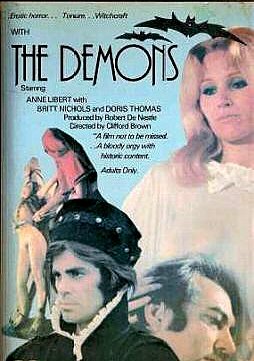
Confronting THE DEMONS in 35mm
Here are some thoughts from Mick Cantone on yesterday's 35mm showing of Jess Franco's THE DEMONS at the ANTHOLOGY FILM ARCHIVES in New York City. It will be shown again on November 9th, at 7:15PM


by Mick Cantone: Regarding
the print of THE DEMONS, it was a VERY battered print that had turned
reddish, as Eastmancolor films tend to do. It was the 79-minute US
theatrical print as per the Dutch VML video release. This print, however
had two scenes grossly misplaced. The scene with the Mother Superior
masturbating was shoved in the middle of the scene where Lady De Winter
and Renfield are examining Kathleen and Margaret in the convent. Also,
the scene where Lady De Winter is orally pleasuring Margaret was
inserted into the middle of the scene where Margaret kills her. After
seeing this print, I came to the conclusion that the scenes were snipped
out by a sneaky projectionist for his private collection and then
crudely inserted back into the film proper. One of the highlights was
finally getting to meet Mirek Lipinski. Very cool guy.
01 November, 2013
TONIGHT IN NEW YORK CITY: TWO JESS FRANCO FILMS IN 35MM!
Jess Franco's VENUS IN FURS and THE DEMONS will screen together tonight at New York's ANTHOLOGY FILMS ARCHIVES. A 35mm showing of any Jess Franco film is a rarity, but a double bill makes this a must see. These are two of the director's more personal and idiosyncratic films. VENUS IN FURS (1969), featuring a great jazz score by Mike Hugg and Manfred Mann, is one the late director's own favorites. THE DEMONS, set against the historical background of the European Inquisition, takes us into the torture chambers of Judge Jeffreys. A wild, progressive rock scored remake of Franco's 1970 THE BLOODY JUDGE... [NOTE: Anyone who attends these showings is invited to write about the films, the prints, the audience, the experience, for this blog. I will publish any feedback here in the next few days. Please contact me by FACEBOOK Message if you are interested. Thanks, Robert Monell]

VENUS IN FURS
by JESS FRANCO
November 1 at 7:15 PM
November 5 at 7:15
THE DEMONS
by JESS FRANCO
November 1 at 9:15 PM
November 9 at 7:15 PM
VENUS IN FURS
by JESS FRANCO
November 1 at 7:15 PM
November 5 at 7:15
THE DEMONS
by JESS FRANCO
November 1 at 9:15 PM
November 9 at 7:15 PM
27 October, 2013
THE HOT NIGHTS OF LINDA:PART 4

The audience in MAIS QUI DONC A VIOLE LINDA?, the 80m softcore version of THE HOT NIGHTS OF LINDA now in 1080p full HD resolution on Blu-ray from Severin Films. This version features the English language track. Onscreen title: BUT WHO RAPED LINDA?
Video
Codec: MPEG-4 AVC
Resolution: 1080p
Aspect ratio: 2.34:1
Original aspect ratio: 2.39:1
Audio
English: DTS-HD Master Audio Mono

The opening title card for THE HOT NIGHTS OF LINDA, the 78m 58s hardcore version which was transferred from a collector's vintage video. This version is in French with English subtitles.
Both are presented in 2.35:1 OAR and both are rare, original release versions.
In telling the story of the final disintegration of this dysfunctional family, within the context of mid 1970s European porn, Jess Franco once again illustrates he is most interested in the style of the telling. Sometimes it seems that he just made one film, over and over and over. That one film could be the story of the cruel, guilt-ridden, sadistic, demented father and his wounded daughter. That tale goes all the way back to GRITOS EN LA NOCHE, filmed in 1961. It would resonate through EUGENIE DE SADE (1970), FACELESS (1988) and into his digital era (BROKEN DOLLS). The setting in LINDA is a Greek island (actually filmed in a villa near Alicante, Spain, chosen by Franco for its Grecian style architecture), with a musical commentary which was carefully crafted to sound Greek in style, played with Greek instruments, according to the director, who once again worked closely with the composer. The music is rousing, at times delicate, exotic and somtimes evocative of a lullaby morphing into a fever dream. The dreamer is Marie-France, whom we find out at the conclusion has dreamed the entire scenario, in an twist ending suggested by Franco's Eurocine producer Marius Lesoeur, to soften the film, make it more salable. The film is circular in structure, as is the music, which seems to go round and round, dancing around the action and players.
As in Franco's 1970 EUGENIE, THE STORY OF HER JOURNEY INTO PERVESION, the enclosed narrative begins and ends with its female protagonist reading a book in bed, which presumably triggers a (prophetic?) dream. The book, as we find out in the final image (another zoom shot), is MAIS QUI DONC A VIOLE LINDA? by "David Khunne," one of Jess Franco's most frequent pen-names. It's one of the numerous lost/faux texts in the Francoverse. The same David Khunne would be credited as writing the "novel" (which has never surfaced) on which GRITOS EN LA NOCHE was based. It's almost as if Franco wanted to deny literary responsibility for his scenarios. His name is nowhere to be found on any version of this film, credited to American Jazz musician J.P. Johnson. In the fascinating HOT NIGHTS documentary interview by David Gregory, Franco floats the name of James Joyce as an influence, reminding us that his late 1990s cannibal epic TENDER FLESH opens with a Joyce quotation. Franco specifically mentions the seminal Joyce novel ULYSSES, in which the stream-of-consciousness style allows for numerous conscious and unconscious points of view. Considering that LINDA is a stream of sexual fantasies, traumatic psycho-sexual memories, guilty flashbacks, hallucinations, RASHOMON like renderings of the murder at the film's core and fetid sexual encounters between various characters, all within Marie-France's organizing dream, Joyce is not an inapt comparison. Time slows down, expands, contracts as the sexual encounters become more frequent and it becomes more and more difficult to discern what is real and what is fantasy. The locked room where Radeck once murdered his best friend and caused the death of his wife when he caught them making love could represent the sealed off area of the Unconscious, which only releases its repressed images in dreams, psychoanalysis and art works.
The film itself is a heated fantasia on themes and images which might have fascinated Jacques Lacan (one thinks of his pyscho-analystic construct, the Mirror Stage), with Franco's frequent, almost obsessive use of mirrors to illustrate the irreality of it all and open up the claustrophobic confines in a distinctly Cubist manner. In the first meeting between Marie-Franco and Olivia in the hardcore version, the bodies of the women are broken up into literal cubes by the villa's doorway, windows and parapets. Something is happening here but we don't exaclty know what it is, and the indirection, fragmentation of it all holds the proceedings in a stylistic suspense until the last moments. The intensity which permeates the atmosphere (especially in the hardcore version) may explain the absence of the director himself in his usual cameo (Basilio in A VIRGIN AMONG THE LIVING DEAD being an obvious example) as a subnormal observer of the action, that role taken this time by Pierre Taylou (KISS ME KILLER's hippie musician) as the mumbling, much abused manservant, Abdul.
The softcore BUT WHO RAPED LINDA? adds layers to the already complex matrix of voyeurism, as the surveillance once again illustrates the director's recurring interest in the interactive nature of performance. He's as fascinated with the audience of the show as he is with the performer, you can't have one without the other, and if the performance is an erotic one, then pornography is in the eye and mind of the beholders. Speaking of pornography, the infamous ravishing by banana must be a low point in the director's checkered career, but one wonders if he even filmed it, as it seems on close examination that it may be yet another Eurocine insert from another film, although Franco did shoot all of the other hardcore material. Even Sade himself may have been hard pressed to find eroticism in a close up of vaginal bleeding.
A further stylistic elaboration comes with the added scenes (one again seemingly at the behest of Eurocine) of the police inspector (Bigotini again) and the sex magazine photographer (Catherine Laferriere, EXORCIMS) who spy on the (offscreen) action via amusing cutaway inserts. Franco speaks of the tonal variation of these scenes in a second documentary, JESS AND LINDA TALK LINDA, which was taped in 2008, and shows the late couple attempting to remember the exact shooting circumstances of LINDA. They are both in good spirits and this is a moving, essential tribute as well as illustration of how Jess Franco and Lina Romay basically operated as one creative unit for decades.
The Bonus Features also include the Fantastic Fest Lifetime Achievement Award Presentation to Franco, rare outtakes, a luridly narrated (in hard-boiled English by a voice which sounds like the dubber of Bigotini in the film) 4 minute (softcore) trailer, and an informed talk on the film by critic Stephen Thrower, who helpfully pinpoints the shooting date of the film as exactly 40 years ago, in October 1973.
Given the numerous versions of this film which have surfaced over the years, I very much appreciated this presentation of two rare alternate versions, one in 1080p HD, the other transferred from a blurry, vintage VHS. The Blu-ray brings out a range of color and detail never seen in all the versions I've collected over three decades and probably looks better than any 35mm theatrical presentation anywhere, anytime. And I, for one, also appreciate those slight imperfections, projector scratches, and occasional glitches which remind us that these versions of this quota quickie were made for quick playoff on international soft and hardcore grindhouse circuits. Having the film on BD, DVD, including the VHS release, on separate discs, all supported by relevant special features, makes this a kind of scholar's edition and is the way to do a Limited Edition of a crucial Jess Franco film.
[Thanks to Eric Cotenas for the screencaps and Kris N. Gavin for his assistance is arranging my interview with Paul Muller]
(C) Robert Monell 2013
25 October, 2013
THE HOTS NIGHTS OF LINDA: PART 3
The Blu-ray transfer of the soft version of this film is, of course, superior in terms of color, definition, focus and detail. It's really quite beautiful in spots, especially the scene where Alice Arno and Lina Romay smoke and talk amidst a purple haze. A very ethereal scene which was used in a different context as the opening credits sequence in Franco's TENDER AND PERVERSE EMANUELLE, made simultaneously with .... LINDA?

But it's nice to have the hard version also, even from an ancient VHS source with the [superior] French soundtrack and new English subtitles. It should also be noted that this film has parallels with NECRONOMICON, LORNA THE EXORCIST, AL OTRO LADO DEL ESPEJO in the way the villain Radeck meets his end getting slashed in the back of the neck by a daemonic, seductive female. A recurring conceit in a career of reverberating images, characters, themes, moments in the teeming filmography of Jess Franco.
Paul Muller, a skilled, prolific Swiss actor who played the drug addicted zombie-kidnapper in Riccardo Freda's 1957 classic I VAMPIRI, confided to me during an interview I conducted with him in 2004 that he was well aware and upset by the often slapdash, deceptive practices Franco would use to get his films made. Muller noted that THE HOT NIGHTS OF LINDA (both soft and hard versions) was made simultaneously with the aforementioned TENDER AND PERVERSE EMANUELLE and "SEXY BLUES" aka KISS ME KILLER, but he was the only actor on set who was in on the scam. He made sure Jess was aware that he was aware and dangled his contract indicating that he better not see himself in two films for the price of one. Muller added, in an exasperated tone, that Jess then proceeded to start yet another film VOYAGE TO ST. TROPEZ, on the same locations, with the same actors, shortly thereafter! That film was later taken over by another Eurocine contract director. Dan Van Husen also told me he was unaware he would be appearing in TENDER AND PERVERSE... while appearing in the film for which he signed, KISS ME KILLER. 1973 was a very busy year indeed for Jess Franco...
Only Jess Franco could make four films simultaneously while pulling the wool over just about everyone's eyes.
21 October, 2013
Further Thoughts on THE HOT NIGHTS OF LINDA
aka PLAISIR SOLITAIRE (FR); LA FELICITA NEL PECCATO (IT); CARESSES DE CHATTES: LINDA, LA MAISON DES PECHERESSES (Belg): Shooting title: MORBOSITA.

Marie-France (Alice Arno, real name Marie-France Broquet) is hired by Bigotini, a somewhat sleazy Parisian agent (Rick Deconninck), as a professional companion to the paralyzed daughter (Veronica Llimera) of the wealthy Mr. Radeck (Paul Muller) at his villa on a Greek island. When she arrives Radeck informs her that she will have to act as a nurse to Linda and deal with his emotionally disturbed niece, Olivia (Lina Romay), a nymphomaniac with a cause, described by Radeck as "a paranoid obsessed with sex."
Everything and everyone in this highly dysfunctional household will be revealed as deceptive and threatening to the increasingly disturbed, and stimulated, Marie-France. Will she be the family's savior, or its victim?
First of all, let's get the titles straight. The main feature here is MAIS QUI DONC A VIOLE LINDA? (BUT WHO RAPED LINDA?), presented with its hardcore, alternate version LES NUITS BRULANTES DE LINDA (THE HOT NIGHTS OF LINDA) as an extra bonus feature on the 3 disc Limited Edition. This was one of over a dozen feature film projects begun by Jess Franco in 1973, which would result in 11 completed films and several intriguing sounding, aborted shoots, such as Le Manoir du Pendu (The Hanged Man's Mansion).
The well-meaning, kindly Marie-France could be one of the exquisitely naive heroines of a 1950s Douglas Sirk melodrama (IMITATION OF LIFE, WRITTEN ON THE WIND) who gets caught up in a whirlwind of psycho-sexual corruption while attempting to keep her bearings. "It's a question of morality," she informs Bigotini, who replies he wouldn't know anything about that. One of the least remarked about aspects of the films of Jess Franco is how he consistently produces what could be termed fables of punishment within the amoral system of European Sexploitation over several distinct eras. His most personal projects, the breakaways, including NECRONOMICON-1967, VENUS IN FURS-1969, LORNA, THE EXORCIST-(1974), to name a few, are about the systematic punishment of libertines by daemonic females. In the world of Jess Franco during this period you can attend an orgy, torture and murder a woman, cheat on your wife, sell your soul to devil, but someone, as the song in VENUS IN FURS goes, will come knocking on your door. But this is just a formal element one also finds in Medieval painting and literature, both of which are directly referenced in NECRONOMICON. The real Jess Franco admired Sade both as a anti-hero and a literary-philosophical visionary. In Sade punishment is always erotic and presented as a kind of psychoanalytic spectacle, a kind of performance art which Jess Franco would start incorporating into his obsessive mise-en-scene from NECRONOMICON onward. Radeck is a classic sadist who whips the mute servant Abdul (Pierre Taylou) in the same set used for the torture dungeon whipping scene in Franco's LA COMTESSE NOIRE, also made in 1973. If this can be viewed as a Sadean melodrama, it also has something in common with the horror genre, a monster. In this film, as in Franco's A VIRGIN AMONG THE LIVING DEAD, THE SADISTIC BARON VON KLAUS, THE SECRET OF DR. ORLOFF and many other titles, the monster is the Family.
At base, Jess Franco, like Goya, Dali, Cervantes, was a Spanish artist, with all the baggage that entails. He might have found himself living in Paris, Rome or wherever but he would always return to Spain, just as Mathis Vogel would return to confess his sins to his colleague at Notre Dame in EL SADICO DE NOTRE DAME.
Franco, like Luis Bunuel, finds much ironic amusement in the punishment of sinners, ever though neither director, both Spanish iconoclasts, was a believer in Jesus or Francisco Franco, inescapable icons in a Catholic country still living under a dictatorship which found something in common with other European Fascist movements from the 1930s onward. LINDA... like Bunuel's VIRIDIANA (1961) is primarily about rape within a family and the fallout from the repression of that fact. Of course, Bunuel's film was famously banned in its homeland and I doubt if Franco's film, although mostly shot in Alicante (the opening was lensed in Paris) played there in any form during the1970s.
NOTE: When I mentioned the Bunuel parallel to Franco during my interview with him in 2004, he quickly replied, "But Bunuel was free, I was not." Actually, Bunuel paid a price for being given carte blanche while Jess Franco paid a different price. LINDA... was a French-Italian co production between Eurocine and Parva films. As we shall see, 1973 would be the year when Jess Franco found a kind of artistic freedom within a strict economic imperative imposed by Eurocine. In the next blog post I'll discuss how this film fulfills a conventional contract while finding a unique cinema structure which the director himself confirms was inspired by the prose experimentation of James Joyce.
(C) Robert Monell, 2013

Marie-France (Alice Arno, real name Marie-France Broquet) is hired by Bigotini, a somewhat sleazy Parisian agent (Rick Deconninck), as a professional companion to the paralyzed daughter (Veronica Llimera) of the wealthy Mr. Radeck (Paul Muller) at his villa on a Greek island. When she arrives Radeck informs her that she will have to act as a nurse to Linda and deal with his emotionally disturbed niece, Olivia (Lina Romay), a nymphomaniac with a cause, described by Radeck as "a paranoid obsessed with sex."
Everything and everyone in this highly dysfunctional household will be revealed as deceptive and threatening to the increasingly disturbed, and stimulated, Marie-France. Will she be the family's savior, or its victim?
First of all, let's get the titles straight. The main feature here is MAIS QUI DONC A VIOLE LINDA? (BUT WHO RAPED LINDA?), presented with its hardcore, alternate version LES NUITS BRULANTES DE LINDA (THE HOT NIGHTS OF LINDA) as an extra bonus feature on the 3 disc Limited Edition. This was one of over a dozen feature film projects begun by Jess Franco in 1973, which would result in 11 completed films and several intriguing sounding, aborted shoots, such as Le Manoir du Pendu (The Hanged Man's Mansion).
The well-meaning, kindly Marie-France could be one of the exquisitely naive heroines of a 1950s Douglas Sirk melodrama (IMITATION OF LIFE, WRITTEN ON THE WIND) who gets caught up in a whirlwind of psycho-sexual corruption while attempting to keep her bearings. "It's a question of morality," she informs Bigotini, who replies he wouldn't know anything about that. One of the least remarked about aspects of the films of Jess Franco is how he consistently produces what could be termed fables of punishment within the amoral system of European Sexploitation over several distinct eras. His most personal projects, the breakaways, including NECRONOMICON-1967, VENUS IN FURS-1969, LORNA, THE EXORCIST-(1974), to name a few, are about the systematic punishment of libertines by daemonic females. In the world of Jess Franco during this period you can attend an orgy, torture and murder a woman, cheat on your wife, sell your soul to devil, but someone, as the song in VENUS IN FURS goes, will come knocking on your door. But this is just a formal element one also finds in Medieval painting and literature, both of which are directly referenced in NECRONOMICON. The real Jess Franco admired Sade both as a anti-hero and a literary-philosophical visionary. In Sade punishment is always erotic and presented as a kind of psychoanalytic spectacle, a kind of performance art which Jess Franco would start incorporating into his obsessive mise-en-scene from NECRONOMICON onward. Radeck is a classic sadist who whips the mute servant Abdul (Pierre Taylou) in the same set used for the torture dungeon whipping scene in Franco's LA COMTESSE NOIRE, also made in 1973. If this can be viewed as a Sadean melodrama, it also has something in common with the horror genre, a monster. In this film, as in Franco's A VIRGIN AMONG THE LIVING DEAD, THE SADISTIC BARON VON KLAUS, THE SECRET OF DR. ORLOFF and many other titles, the monster is the Family.
At base, Jess Franco, like Goya, Dali, Cervantes, was a Spanish artist, with all the baggage that entails. He might have found himself living in Paris, Rome or wherever but he would always return to Spain, just as Mathis Vogel would return to confess his sins to his colleague at Notre Dame in EL SADICO DE NOTRE DAME.
Franco, like Luis Bunuel, finds much ironic amusement in the punishment of sinners, ever though neither director, both Spanish iconoclasts, was a believer in Jesus or Francisco Franco, inescapable icons in a Catholic country still living under a dictatorship which found something in common with other European Fascist movements from the 1930s onward. LINDA... like Bunuel's VIRIDIANA (1961) is primarily about rape within a family and the fallout from the repression of that fact. Of course, Bunuel's film was famously banned in its homeland and I doubt if Franco's film, although mostly shot in Alicante (the opening was lensed in Paris) played there in any form during the1970s.
NOTE: When I mentioned the Bunuel parallel to Franco during my interview with him in 2004, he quickly replied, "But Bunuel was free, I was not." Actually, Bunuel paid a price for being given carte blanche while Jess Franco paid a different price. LINDA... was a French-Italian co production between Eurocine and Parva films. As we shall see, 1973 would be the year when Jess Franco found a kind of artistic freedom within a strict economic imperative imposed by Eurocine. In the next blog post I'll discuss how this film fulfills a conventional contract while finding a unique cinema structure which the director himself confirms was inspired by the prose experimentation of James Joyce.
(C) Robert Monell, 2013
20 October, 2013
THE HOT NIGHTS OF LINDA BLU-RAY + DVD COMBO from SEVERIN
Alice Arno is a Douglas Sirk heroine who enters up in James Joyce conundrum in the House of the Marquis De Sade. Yes, it's Jess Franco all over again! I first watched this 1973 Jess Franco film on a blurry, color faded VHS courtesy of VIDEO SEARCH OF MIAMI about 20 years ago. I was happy to get it since it was such an obscure film, one of 11 films the prolific director completed during one of his most creative outbursts. Watching this beautiful new Blu-ray transfer was like seeing it for the first time. The colors are luminous, it looks as well-composed and sharp as a Jess Franco film can, and I noticed a universe of fascinating visual detail which was suppressed by the general scuzziness of the 10 previous alternate versions I have collected on VHS over the last few decades.
I'll have much more to say about this must-have 3 disc set in future blog posts. It's simply one of the best-ever presentations of a Jess Franco film when experienced on this Limited Edition.
15 October, 2013
More New Blu-ray releases
These two Jess Franco films, both made in the prolific year of 1973, were released on August 8 by Severin and Mondo Macabro. We're awaiting screeners for future review.
Les nuits brûlantes de Linda / La Felicita nel Peccato / Blu-ray + DVD
Severin Films | 1975 | 77 min | Not rated | Oct 08, 2013

And from MONDO MACABRO
The beautiful Countess Martine de Bressac
is released from the expensive asylum where she was incarcerated after
castrating her former lover. She returns to her luxurious villa on the coast
and goes at once down into her private underground dungeon....
The Hot Nights of Linda Blu-ray |
And from MONDO MACABRO
Released Today – October 8th,
2013
How to Seduce a Virgin
Directed
by Jess Franco
Amazon.com: How To Seduce A Virgin: Robert Woods, Alice Arno ...
14 October, 2013
Jack the Ripper Blu-ray
CINEMADROME - THE WORLD OF JESS FRANCO FORUM - Jack the Ripper blu-ray
Here are some reports on the new Ascot BD's of JACK THE RIPPER...
Jack The Ripper – Der Dirnenmörder von London
Ascot Elite Home Entertainment | 1976 | 92 min | Rated FSK-18 | Sep 24, 2013
Jack the Ripper Blu-ray delivers great video and audio in this excellent Blu-ray release
No synopsis for Jack the Ripper.
For more about Jack the Ripper and the Jack the Ripper Blu-ray release, see the Jack the Ripper Blu-ray Review published by Dr. Svet Atanasov on October 12, 2013 where this Blu-ray release scored 4.0 out of 5.
Starring: Klaus Kinski, Lina Romay, Herbert Fux, Josephine Chaplin, Andreas Mannkopff
Director: Jesús Franco
» See full cast & crew

Presented in an aspect ratio of 1.78:1, encoded with MPEG-4 AVC and granted a 1080p transfer, Jess Franco's Jack the Ripper arrives on Blu-ray courtesy of German label Ascot Elite Home Entertainment.
Here are some reports on the new Ascot BD's of JACK THE RIPPER...
Jack the Ripper Blu-ray |
|
Video Codec: MPEG-4 AVC Resolution: 1080p Aspect ratio: 1.78:1 Original aspect ratio: 1.85:1 Audio
English: DTS-HD Master Audio 5.1
German: DTS-HD Master Audio 5.1 Italian: DTS-HD Master Audio 5.1 French: Dolby Digital 2.0 Subtitles
Japanese, Dutch, Finnish, Greek, Mandarin (Traditional)
Discs 50GB Blu-ray Disc Single disc (1 BD) Playback Region free |
Price List price: €9.28 Third party: €9.95 Gewöhnlich versandfertig in 24 Stunden
BUY NOW »
Movie rating
0
ratings.Movie appeal
92%
6popularity collections 0 fans |
| Overview | Blu-ray review | Screenshots | (20) | User reviews | Region coding | News | Forum |
Jack the Ripper
(1976)No synopsis for Jack the Ripper.
For more about Jack the Ripper and the Jack the Ripper Blu-ray release, see the Jack the Ripper Blu-ray Review published by Dr. Svet Atanasov on October 12, 2013 where this Blu-ray release scored 4.0 out of 5.
Starring: Klaus Kinski, Lina Romay, Herbert Fux, Josephine Chaplin, Andreas Mannkopff
Director: Jesús Franco
» See full cast & crew
Jack the Ripper Blu-ray, Video Quality
Presented in an aspect ratio of 1.78:1, encoded with MPEG-4 AVC and granted a 1080p transfer, Jess Franco's Jack the Ripper arrives on Blu-ray courtesy of German label Ascot Elite Home Entertainment.
13 October, 2013
LAST TANGO IN SITGES
This
had it's premiere yesterday, 11 October 2013, in Spain (Sitges Film
Festival). Filmed in Spain and Germany this was completed by
Actor-Director Antonio Mayans after the death of Jess Franco earlier
this year. Our correspondent Nzoog was there and we will have a review
up on CINEMADROME asap.
05 October, 2013
DOWNTOWN: JESS FRANCO GOLDEN GOYA COLLECTION BLU-RAY COMING
Für eine größere Ansicht klicken Sie auf das Bild
|
Downtown - Die nackten Puppen der Unterwelt (Goya Collection) [Blu-ray]
Jesus Franco (Darsteller), Lina Romay (Darsteller), Jess Franco (Regisseur) | Alterseinstufung: Freigegeben ab 18 Jahren | Format: Blu-ray
| ||||||||
|
Dieser Artikel wird am 19. November 2013 erscheinen.
Bestellen Sie jetzt. Verkauf und Versand durch Amazon. Geschenkverpackung verfügbar. | ||||||||
|
Achtung: ab 18! Eine Lieferung an Minderjährige ist nicht möglich. Klicken Sie bitte hier für weitere Informationen.
| ||||||||
Blu-rays im Sparpaket: 3 für 22 EUR.
30 September, 2013
Master Class: Jean-Pierre Bouyxou (2013) Directed by Nicole Brenez
- Recommended for you
-
1:12:06
Master-Class - In French only. This is a rather amazing experimental film which stretches the boundaries of documentary. The subject is a Master Class presided over by film historian, critic, writer, actor, director and former Jess Franco colleague (he played Dr. Orloff in LA COMTESSE NORIE), Jean-Pierre Bouyxou. If you don't understand French stay with it for the visual elements, which include rare footage from the career, films and times of the subject.
29 September, 2013
GIRLS IN THE NIGHT TRAFFIC 1976 English Friendly
Girls In The Night Traffic 1976 (Swiss w/ Eng Subs) A Jess Franco Erotic Comedy.flvflash nsfwAka Madchen Im Nachtverkehr. The story is about 3 high class Zurich hookers who while not working play with each other and gossip about their strange clients. When |
28 September, 2013
Today, in Paris!
I wish I could have traveled to Paris for this event.
Unlike · · Share · about an hour ago ·
Daniel
Lesoeur/JA Lazer/Claude Plaut/AM Frank/AL Mariaux/Dan Simon en pleine
Alainpetit-exploitation (merci pour cet après-midi!).
Daniel Vishwas/JA Lazer/Claude Plaut/AM Frank/AL Marian / Dan Simon in full Alainpetit-operation (thanks for this afternoon!). (Translated by Bing)
Unlike · · Share · about an hour ago ·
Daniel Vishwas/JA Lazer/Claude Plaut/AM Frank/AL Marian / Dan Simon in full Alainpetit-operation (thanks for this afternoon!). (Translated by Bing)
19 September, 2013
HAPPY BIRTDHAY, MONIKA SWINN
HAPPY BIRTHDAY TO MONIKA SWUINE, a uniquely talented Actress, Artist and Photographer....
She is especially memorable in such Jess Franco films as LA COMTESSE NOIRE [FEMALE VAMPIRE], EXORCISM, BARBED WIRE DOLLS and DORIANA GRAY. She also appears in Jean Rollin's LES DEMONAIQUES and other cult/underground/experimental films.
16 September, 2013
CINEMADROME - HORROR RISES FROM SPAIN - Horror Rises from Spain 3.1: Diego Arjona
In the September podcast I review the Spanish DVD of Jess Franco's final film and the recent Redemption Blu-ray releases of THE AWFUL DR. ORLOF, NIGHTMARES COME AT NIGHT and A VIRGIN AMONG THE LIVING DEAD. Thanks to Elena....

In the September podcast I review the Spanish DVD of Jess Franco's final film and the recent Redemption Blu-ray releases of THE AWFUL DR. ORLOF, NIGHTMARES COME AT NIGHT and A VIRGIN AMONG THE LIVING DEAD. Thanks to Elena....
10 September, 2013
The Awful Dr. Orlof, the Blu-Ray: Guest Review by Mirek Lipinski
Comparison screen captures of GRITOS EN LA NOCHE/THE AWFUL DR. ORLOF from, top to bottom: 1) the Image DVD, 2) the Spanish Regia DVD, and 3) the Kino Blu-Ray, the latter courtesy of Mondo Digital (www.mondo-digital.com). The inadequacy of the Kino version should be evident. While offering more side information and sharpness, the picture lacks the vital interplay between black and white and their various shadings, a requirement for good black and white cinematography. Almost completely missing in the Kino capture is the white light of the candles, the left glow beyond the door, and the sensual dimensions of actress Diana Lorys' skin and dress.
The lineup is impressive: Nigel Wingrove and his Redemption label, which has for decades brought euro-horror to fans and the public, David Gregory, the premiere interviewer/supplement director for many euro-horror DVD and Blu-Ray releases, and Tim Lucas, whose credentials are impeccable. The result of this convergence, however, is a regrettable disappointment.
Right off the bat, it must be stated that any release of
GRITOS EN LA NOCHE that doesn’t include the Spanish version is already facing a
serious deficit. The Spanish version is the true landmark film that Franco shot
in 1961. By not showing this version, viewers are denied about 11 minutes of
the original film and the appreciation of what the Spanish audio reveals, which in a
couple of key scenes is an absent musical score that lets silence and natural sounds accent the tension and illuminate key scenes with the blind Morpho (Ricardo Valle). The tension is particularly
heightened in the sequence where Morpho, by hearing, follows a wandering Wanda (Diana Lorys) in Orlof's castle, guided by the sound of her movement. Yes, we do get the clunky nude inserts that
were mandated by Eurocine and probably, but not certainly, shot by Franco. These two scenes would be perfectly deposited
in “extras” as they are not imperative
in the body of the film where they distract. Undoubtedly, rights to the Spanish version
were either difficult and/or too expensive to acquire, so this deficit is
understandable, though still persistently unfortunate.
As with the Blu-Rays of BLACK SUNDAY (the Kino and Arrow release), THE AWFUL DR. ORLOF suffers from a transfer that dilutes in
many parts the black and white photography of its cinematographer, in this case Godofredo Pacheco. At times we seem to be
witnessing a peculiar solarized grey that robs a scene of impact and annoys. The dynamic power of black and white, its
sleazy, shadowy invocations when dealing with horror or exploitation films, are
gone. Naturally, with the high resolution,
the viewer will notice visual minutia missed before: In one scene I could see, remarkably, the
abraded threads of loosened wallpaper.
While such sightings may be revelatory and impressive, much more
important, I think, is seeing the chiaroscuro power of the entire film, the essential strength of black and white that, in the right hands, can be breathtaking. Courtesy Bob Furmanek’s 3D Film Archive, I recently
had the opportunity to see a 35mm trailer for the American version, and it was
more dynamic and even awe-inspiring in those few minutes than any replication
of this film I have ever seen. The Blu-Ray release is particularly lacking the intensity
of the original film element, and, aside from the absence of a Spanish version,
this is its major shortcoming.
With the Franco interview in the Kino Blu-Ray we probably have the final
words of Franco on the topic of GRITOS EN LA NOCHE. It seems, however, that the main question
asked of Jess was the one to get him started: “So tell us about GRITOS?” Franco rambles on, entertaining and mischievous
and lovable as always, but offering up no significant new information. Could not the interviewer, given what could
have been surmised as the last words of Franco on the subject, have poised
questions not typically asked of Franco of this film: Did Franco
shoot the nude scenes for a French version?
If yes, was he anxious in doing so, considering the Spanish government’s prohibitive stance on nudity in films? How was it shooting at
the San Martin de Valdeiglesias castle, a location Franco used before and after GRITOS? What other locations were used in the
film? Did actor Conrado San Martin offer financial assistance to the production?
None of these imperative questions are
asked. Sure, Franco could have lied his
head off in response, but then his words would have been before us to evaluate. An opportunity lost that can never be
retrieved. (The other featurette I saw—memories of the film from French cinephiles—is of more
interest.)
Doing a commentary for GRITOS EN LA NOCHE is a thankless job, no doubt. Whatever little information exists about this
film has already been regurgitated among Francophiles, and, aside from Franco
and Vernon, no interviews are readily available from its cast or crew. Tim Lucas braves it out, but finds himself
weaving too much among IMDB factoids (so-and-so was born on____; so-and-so made his/her last film in the
year____, etc.) not to suspect an over-reliance on them. Then, too, there were,
surprisingly, a number of erroneous statements and highly dubious theories put
forth. I had to do a mental double-take
and speed my player back to the scene a couple of times when Tim spoke of the
light illuminating Orlof's face in the cabaret scene with Dany (Maria Silva) as
coming from the necklace presented to her, when it's very clear that the light
is coming from a reflection off the compact mirror she is looking at to admire
the necklace around her neck. In referencing the Spanish version, Tim mentions that
the operation on the face of the Mara Lasso character ends in a fade-to-black,
but it actuality cuts to Morpho standing nearby. Tim suggests that Orlof,
after accidentally stabbing Arne (Perla Cristal), considers using her skin for an
operation on his daughter, when it appears clear to me that the distraught
Orlof is placing the blade of the scalpel to her nose to see if any breath will
appear on it. (The scene is played too quickly, to be sure, but the implication
remains.) In listing the films Maria
Silva co-starred with Paul Naschy, Tim includes I HATE MY BODY, which is not a
Naschy film, though its director, Leon Klimovsky, is a familiar presence in
Naschy's filmography. He states that the
name of Orlof is taken from the Edgar Wallace novel, THE DARK EYES OF LONDON,
when the novel doesn’t have any Orlof--or Orloff--in it. (That name would be
created for the 1939 film of the book.) He
insists that Franco must have been influenced by the German film version of the
novel, DIE TOTEN AUGEN VON LONDON (DEAD EYES OF LONDON), but that film was in production in the same year as GRITOS and
did not have a Spanish exhibition until a few years later.
Tim also mentions that nowhere in its theatrical showings, domestic or international, was GRITOS exhibited under the name "Jess Franco," but he does mention that the Spanish release contains the directorial credit of "Jesus Franco"--Franco's real name--so I'm not sure why this is of import, unless the commentary would follow through, which it doesn’t, on when and why Franco, or his producers, began using "Jess" instead of "Jesus."
Tim toys with the intriguing possibility (implying it may be a long shot, thankfully) of the elderly flower lady seen later in the film as being Franco’s mother, but the actress, Mercedes Manera/Manero, is listed as being in other films before this one, and Franco notes in his autobiography, MEMORIAS DE TIO JESS, that his mother was small and plumpish, hardly the woman we see in the role. In a bit of trump card playing, Tim presents toward the end of the commentary the concept that GRITOS is “Jewish film.” There is some validity to this. Yes, the producers were Jewish (something Tim doesn’t mention) and Franco has claimed Jewish blood, but just how Tim figures that Orlof is taken from the Polish name Orlowski is puzzling and, further, why "Orlowski" would then be a Jewish name is beyond me. I like speculation, btw, and use it, but it has to face the evidence of facts to remain even remotely credible.
Tim also mentions that nowhere in its theatrical showings, domestic or international, was GRITOS exhibited under the name "Jess Franco," but he does mention that the Spanish release contains the directorial credit of "Jesus Franco"--Franco's real name--so I'm not sure why this is of import, unless the commentary would follow through, which it doesn’t, on when and why Franco, or his producers, began using "Jess" instead of "Jesus."
Tim toys with the intriguing possibility (implying it may be a long shot, thankfully) of the elderly flower lady seen later in the film as being Franco’s mother, but the actress, Mercedes Manera/Manero, is listed as being in other films before this one, and Franco notes in his autobiography, MEMORIAS DE TIO JESS, that his mother was small and plumpish, hardly the woman we see in the role. In a bit of trump card playing, Tim presents toward the end of the commentary the concept that GRITOS is “Jewish film.” There is some validity to this. Yes, the producers were Jewish (something Tim doesn’t mention) and Franco has claimed Jewish blood, but just how Tim figures that Orlof is taken from the Polish name Orlowski is puzzling and, further, why "Orlowski" would then be a Jewish name is beyond me. I like speculation, btw, and use it, but it has to face the evidence of facts to remain even remotely credible.
I winced badly almost every time Tim spoke a Spanish name or a Spanish film title. There were frequent enough occurrences of this that proved so distracting to me that I had to pause the commentary and return to it at a later time when I had calmed down. I think it’s incumbent on anyone doing a film commentary, which demands far more preparation than, say, an interview, to make the attempt to approximate the proper pronunciation of a name or title in a foreign language. (I could do without the attempt to mimic the Castilian lisp, though.) Spanish is one of the easiest languages to find someone who can render phonetic help. Certainly using in this capacity Elena Anele, for instance, whom we all know from her HORROR RISES FROM SPAIN audio blog, would have been prudent. Emailing and then Skyping with her should have solved the problem.
There are several high points in Tim’s commentary, to be sure, and Tim employs his familiar erudite and occasional poetic manner to make one appreciate his smooth intelligence and be charmed, overall, by his commentary. But as a track of substance and value, the commentary falls short and simply bewilders at points.
The release of THE AWFUL DR ORLOF as a Blu-Ray certainly makes
business sense. It’s a title that excites the Franco and euro-horror fan, and
can even intrigue the Universal classic horror aficionado. But the result, particularly as several renowned
principals were involved, makes one achingly wish for something far different. All one asks is that the film be done right
by the sterling and wide-ranging possibilities of the Blu-Ray format. Such is not the case here.
06 September, 2013
Jess Franco Blu-rays: Comments/Critiques?
I'm opening up the blog for reader's comments/critiques on the 3 recent Jess Franco Blu-rays. The ups and downsides can be mentioned in detail in the comment section. I'll publish a sample in a future post. I think it's important that this blog be more interactive and that JF enthusiasts get to air their compliments and complaints.
For my part, I must admit, before turning to a detailed look at the VIRGIN AMONG THE LIVING DEAD BD, and reconsidering the film itself, is still in need of a full restoration. I'm not sure of the availability of negative elements but some scenes are very dark, although that may be due to shooting conditions. Also, the color, contrast and sharpness need improving and the images needs a general cleaning as is done frame by frame in a restoration.
The fact that you get another version of the film, with the Jean Rollin directed zombie inserts and the Eurocine erotic inserts, is a very good special feature. I had never seen this particular variant before. I also enjoy the additional sleazy softcore erotic "lawn orgy" featuring Alice Arno which is also included in the special features. But the image still could be improved. In terms of video quality I would rate it a C or C - at best. After repeat viewings I now have concluded the disc is still recommended for its numerous special features and this is the best it has looked on home video but that best still leaves something to be desired.
Please let me know your reactions below.
Subscribe to:
Posts (Atom)