Eric Usher is, according to his own account, a 100 year old crumbling monument. One immediately gets the overwhelming impression of an ancient living statue in a crushing vision of the classic story.

24 April, 2021


20 April, 2021
Women In Peril: Brigitte Lahaie; Jess Franco; Alain Robbe-Grillet.
EDEN AND AFTER/L’Eden et apres (1970): The shot captured below appears for less than one second of screen time and
acts as a subliminal flash which doesn’t register immediately to the eye
but is retained in the mind. The image is highly stylized, a depiction
of a nude woman lying a bath of red liquid, signifying blood. The
picture on the raised portion of the tub is of the lead actress,
Catherine Jourdan.

De Nesle, who achieved fame and fortune producing sword and sandal films in the early 1960s (SAMSON, HERCULES VS. MOLOCH) by this time was targeting the French porn circuit with his productions. He went so far as to order Franco to shoot post production hardcore porn inserts for such films as LA COMTESSE PERVESE (1973).

The positioning of the pistol suggests that the woman has shot
herself. But there is no realism here outside of what is arranged as a
transgression. An aesthetic shock of flesh, red, white, like an
abstract painting. The fact that it registers subliminally rather than
as readable image completes the transgression. And it illustrates how
Robbe-Grillet was an abstract painter in his writing and films. It’s
also an example of the influence of Sade on his prose and cinema. 
When discussing Sade in cinema it’s difficult to minimize the
filmography of Jess Franco. He returned to “The Divine Marquis” as an
inspiration again and again, adapting his novel Justine (1791), his story Eugenie De Franval (1788). Sade's epic “Dialogues” Philosophy in the Bedroom (1795)
was filmed by Franco as EUGENIE, THE STORY OF HER JOURNEY INTO
PERVERSION, released in 1970, featuring Christopher Lee as the Sadean
narrator Dolmance. Other Sade adaptations followed until the end of his career in 2013

I recently streamed N. A PRIS LES DES… an intriguing 1971 feature by novelist-filmmaker-theorist Alain Robbe-Grillet on the Fandor Amazon channel. It was well worth it since the film is an experimental restructuring of his 1971 L’EDEN ET APRES (EDEN AND AFTER), which was also filmed in Bratislava and Tunisia with the same cast and a similar plot. But plot is not as important as image and soundtrack in ARG’s universe, where character and story are one or two dimensional pulp devices. All of his films have a pulp fiction quality which is very upfront and intentional. (I have since acquired the excellent Kino Classics Blu-ray of EDEN AND AFTER which contains N. A PRIS LES DICE as a bonus feature. It's highly recommended.) N... can accurately be described as a totally self-reflexive work in which an onscreen narrator deconstructs and comments on the film as we watch it.
ARG was a contemporary and kindred spirit to Jess Franco. Both were
immersed in the literature, imagery and philosophy of the Marquis de
Sade. Franco actually adapted several of his books, including JUSTINE,
JULIETTE (unfinished), PHILOSOPHY IN THE BOUDOIR and EUGENIE DE SADE, to
name a few. ARG’s films are awash in Sadean imagery, in which
sadomasochism is visualized and discussed throughout.
Robbe-Grillet’s name is mentioned during the word game in
SUCCUBUS/NECRONOMICON (1967) and Franco’s VENUS IN FURS is a virtual
remake of ARG’s debut feature, L’IMMORTELLE (1963). Both films feature a
search for an elusive woman who represents and delivers death to the
man who finds her. N. A PRIS LE DES… and its template both feature a
woman (Catherine Jourdain LE SAMOURAI) who ends up imprisoned in a
Tunisian torture complex, where women are kept in hanging cages by
pirates with clandestine motives. Misogynist? Maybe. Is it Art? It
depends on personal definitions. What is art to one person, may be mere
pornography to others. Where does eroticism end and pornography begin?
What Robbe-Grillet does as director is arrange aesthetically endowed
S&M tableaux in various sequences.
The key question is: can eroticism be a subject and technique in art? I think most would answer yes to that. It's been an artistic device since the art and literature of antiquity. Robbe-Grillet never worked
in the hardcore sex mode, as did Jess Franco, but he did create a
series of erotic conundrums in his books and films which transgress
common definitions of taste and are pornographic to some. His film
SUCCESSIVE SLIDINGS OF PLEASURE (1974) actually was the subject of
criminal litigation in Italy, was subsequently banned there and ordered destroyed.
ARG is mainly interested in presenting films and books as
experiments in anti/non/multi linear-narrative and alternate
literary/film forms. Conventional representation is critiqued, ridiculed
and turned inside-out. Eroticism is often a portal to a dangerous type
of personal/political freedom, although his films don’t deal with
specific political matters, as do those of Jean-Luc Godard. It’s all a
game, which the viewer is invited to enjoy, one which allows and encourages reader/viewer
participation. The meaning is provided by the reader viewer, as the
narrator assures us in the last moments of N. A PRIS LE DES, a film
which directly addresses the audience with respect and conspiratorial
intimacy. N…. projects the film we are watching as a game of chance,
and is a separate film from EDEN AND AFTER.
In 1975 I had the chance to see EDEN AND AFTER presented with a
following Q&A by Robbe-Grillet. The second feature was the even more
transgressive, SUCCESSIVE SLIDINGS OF PLEASURE, an eyeful for the
first time viewer. . I was somewhat shocked by the intensity of the
sadomasochistic imagery in the latter, and it had trouble finding wide
release in France or any release in North America at the time.
Robbe-Grillet was teaching in New York at the time and was a most
interesting host for his films, appearing bemused as he answered questions
politely and gratefully.
So, how does Jess Franco, generally considered a commercial hack with a
penchant for arty pornography, fit into this dangerous game?
Consider his 1978 I'M BURNING UP ALL OVER, one of his last films produced by Robert De Nesle.

De Nesle, who achieved fame and fortune producing sword and sandal films in the early 1960s (SAMSON, HERCULES VS. MOLOCH) by this time was targeting the French porn circuit with his productions. He went so far as to order Franco to shoot post production hardcore porn inserts for such films as LA COMTESSE PERVESE (1973).
Here's what I thought of I'M BURNING UP ALL OVER when I reviewed it on Mobius Home Video Forums over 20 years ago:
aka
JE BRULE DE PARTOUT.
Directed by Jess Franco (credited as Jacques Aicrag). Jenny Goldstone
(Susan Hemingway) is abducted after a night at a popular discotheque.
She
is the most recent victim to fall into the hands of an international
white slavery cartel. The point person is the beautiful, blond Lorna
(Brigitte Lahaie/Van Meerhaegue) who, along with her henchmen, bundles
the girls aboard a ship fitted with an orgy room into which a sedating
"love drug" is piped. They are transported to a brothel in Portugal
where one of Jenny's customers will turn out to be her own father,
ironically revealed to be the financier behind the ring. But there is
someone else on the trail of the abductors, a certain investigator whose
name will be familiar to those familiar with the filmography of Jess
Franco, Al Pereira.
One of Jess Franco's more obscure sexploitation efforts, this one is of note mainly for the alluring presence of Ms. Lahaie who would go on to be featured in several memorable Jean Rollin titles (FASCINATION, NIGHT OF THE HUNTED). Lahaie, like Rita Calderoni or Rosalba Neri, is one of those Euro-cult actresses whose stunning beauty is equaled by a formidable acting talent. She can play a mean bitch (as here, or in FACELESS) or a pathetic victim (cf NIGHT OF THE HUNTED), and sometimes a bit of both (cf FASCINATION). This was shot in less than a week and really looks it. The "love drug" sequences are represented by smoke being forced through crudely cut rubber tubes. The love drug concept also turns up in the JF filmography as early as THE GIRL FROM RIO asa SUMURU 2 (1968), and is also prominent in CAPTIVE WOMEN aka LINDA/NAKED SUPERWITCHES OF THE RIO AMORE (1980) {see the self-explanatory still on p 143 of OBSESSION: THE FILMS OF JESS FRANCO to get a taste of the latter title}.
One of Jess Franco's more obscure sexploitation efforts, this one is of note mainly for the alluring presence of Ms. Lahaie who would go on to be featured in several memorable Jean Rollin titles (FASCINATION, NIGHT OF THE HUNTED). Lahaie, like Rita Calderoni or Rosalba Neri, is one of those Euro-cult actresses whose stunning beauty is equaled by a formidable acting talent. She can play a mean bitch (as here, or in FACELESS) or a pathetic victim (cf NIGHT OF THE HUNTED), and sometimes a bit of both (cf FASCINATION). This was shot in less than a week and really looks it. The "love drug" sequences are represented by smoke being forced through crudely cut rubber tubes. The love drug concept also turns up in the JF filmography as early as THE GIRL FROM RIO asa SUMURU 2 (1968), and is also prominent in CAPTIVE WOMEN aka LINDA/NAKED SUPERWITCHES OF THE RIO AMORE (1980) {see the self-explanatory still on p 143 of OBSESSION: THE FILMS OF JESS FRANCO to get a taste of the latter title}.
I term all the above mentioned
titles as Women-In-Peril, a related offshoot of the Women-in-Prison
genre, also a goldmine for JF. Some plot elements, especially the
father-daughter erotic complications, are also present in Franco's
COCKTAIL SPECIAL, another adaptation of Sade's PHILOSOPHY IN THE
BEDROOM, also made in 1978, the reported year of Robert De Nesle's
death.
It has been 20 years since I first published this review and there is still no HD/OAR/English friendly DVD/BD (of which I'm aware) to be found anywhere. You may be able to find it on some Internet torrents with English subs. One thing is for sure, both Franco and Robbe-Grillet were endlessly fascinated by images of captive women in chains, bondage or in cages. Franco formalized this interest in his Women-In-Prison films for Harry Alan Towers, Eurocine, Erwin Dietrich and in his 1980s films. The most noticeable difference is Franco's WIP films are never arty or slick whereas Robbe-Grillet's images of women in cages in EDEN AND AFTER and some other of his films are almost suitable for framing. Seeing I'M BURNING UP... again recently I was struck by how little dialogue there is in the film. It opens with a long scene in a disco as Ms Lahaie dances it up while recruiting women for future capture. The victims are kidnapped and taken to an offshore cargo ship by speedboat. No dialogue needed here. It's all very straightforward.
Ms.
Lahaie apparently quarreled with
Franco on set and she doesn't look like a happy camper, but she does
look terrific and can act, as she verified forever in Jean Rollin's
NIGHT OF THE HUNTED and Franco's FACELESS (1988)! My favorite part was
the opening, set in a glittering
disco. Franco pans up from Lahaie's black leather boots to the neon
colored-light show and you immediately know you're in Jess Franco
territory (despite the use of one of his rarer pseudonyms during the
amusing spoken credits). The director even manages to work in his
trademark Al
Pereira P.I. character, but Jean Ferrere's thug-like visage is no
match for the more ambiguous mug of Antonio Mayans, my own favorite
interpreter of JF's favorite Private Eye. Daniel J. White's
moody jazz score adds a dash of much needed atmosphere.
This rather obscure title was one of three hardcore quickies produced by the late Robert de Nesle and directed by Franco in 1978, the year of the producer's death and one of the director's less than favorite years.
NOTE: I have recently come across this quote from Brigitte Lahaie in a 2009 interview on the website PSYCHOVISION "Jess [Franco] who has a certain talent unfortunately ruined by some confusion [...]." This was about 20 years after Franco give her role of the female villain in his gore epic FACELESS (1988), in which she was absolutely terrific. I guess she was thinking of her more negative experiences on JE BRULE DE PARTOUT. by Robert Monell at Mon, May 01, 2000, 18:04:23
--modified by Robert Monell at Mon, May 01, 2000, 18:57:19.
This rather obscure title was one of three hardcore quickies produced by the late Robert de Nesle and directed by Franco in 1978, the year of the producer's death and one of the director's less than favorite years.
NOTE: I have recently come across this quote from Brigitte Lahaie in a 2009 interview on the website PSYCHOVISION "Jess [Franco] who has a certain talent unfortunately ruined by some confusion [...]." This was about 20 years after Franco give her role of the female villain in his gore epic FACELESS (1988), in which she was absolutely terrific. I guess she was thinking of her more negative experiences on JE BRULE DE PARTOUT. by Robert Monell at Mon, May 01, 2000, 18:04:23
--modified by Robert Monell at Mon, May 01, 2000, 18:57:19.
It has been 20 years since I first published this review and there is still no HD/OAR/English friendly DVD/BD (of which I'm aware) to be found anywhere. You may be able to find it on some Internet torrents with English subs. One thing is for sure, both Franco and Robbe-Grillet were endlessly fascinated by images of captive women in chains, bondage or in cages. Franco formalized this interest in his Women-In-Prison films for Harry Alan Towers, Eurocine, Erwin Dietrich and in his 1980s films. The most noticeable difference is Franco's WIP films are never arty or slick whereas Robbe-Grillet's images of women in cages in EDEN AND AFTER and some other of his films are almost suitable for framing. Seeing I'M BURNING UP... again recently I was struck by how little dialogue there is in the film. It opens with a long scene in a disco as Ms Lahaie dances it up while recruiting women for future capture. The victims are kidnapped and taken to an offshore cargo ship by speedboat. No dialogue needed here. It's all very straightforward.
(C) Robert Monell, 2021
05 April, 2021
Pamela Stanford Interview
mona <monadelaunay@free.fr>
Fri 6/11/2010 4:57 PM
Me too.
----- Original Message -----From: Monell RobertTo: mona delaunaySent: Friday, June 11, 2010 10:38 PMSubject: RE: AtlantisJess Franco made several films about interdimensional travel LA COMTESSE NOIRE and SHINING SEX, that subject interests me a lot. Also, the continents of Atlantis, Mu.
From: monadelaunay@free.fr
To: monell579@hotmail.com
Subject: Fw: Pamela Stanford images> LES GRANDES EMMERDEUSES
Date: Fri, 11 Jun 2010 22:24:17 +0200
I don't know if he was interested in entities on the moon, but he talked a little a bit about that subject. I think his mind was opened in a lots of subjects.
----- Original Message -----From: monaTo: Monell RobertSent: Friday, June 11, 2010 10:16 PMSubject: Re: Pamela Stanford images> LES GRANDES EMMERDEUSES
Once Jess talked among other UFO subjects about people driving their car not to far from their house USA or France and suddenly driving thousands miles (for example australia)
----- Original Message -----From: Monell RobertTo: mona delaunaySent: Friday, June 11, 2010 9:45 PMSubject: RE: Pamela Stanford images> LES GRANDES EMMERDEUSES
i
Jess was interested in entities on the moon? Here's a French video f Celestine

From: monadelaunay@free.fr
To: monell579@hotmail.com
Subject: Re: Pamela Stanford images> LES GRANDES EMMERDEUSES
Date: Wed, 9 Jun 2010 19:03:43 +0200
I do not remember the cat mask.When Jess was filming he sounded very careful of his work. He did not especially joke with me but when we were all at the restaurant he told stories and anecdotes about his other films or actors he worked with. He was not very joking but some of the anecdotes he said was funny or interesting. He sounded and probably still is fond of food. He talked about the good courses and the good restaurants he knew.Educated. He knew a lots of things about many different subjects. What I remember the most (probably because it is my hobby and already was in that time) about abducted p eople and I think I don't remember exactly talked about entities on the Moon
----- Original Message -----From: Monell RobertTo: mona delaunaySent: Tuesday, May 18, 2010 7:30 AMSubject: RE: Pamela Stanford images> LES GRANDES EMMERDEUSESDear Monique, I just watched you in LES GRANDES EMMERBEUSES. You are very funny in it. You wear a tight leopard skin costume with pullover cat mask. Do you rmember the cat mask. With Lina Romay. That was filmed in Portugal in 1974, I think April 1974. What was Jess Franco like personally during the filming in Paris? Did he joke with you. The photography of that film is very interesting to me.
From: monadelaunay@free.fr
To: monell579@hotmail.com
Subject: Re: Pamela Stanford images> LES GRANDES EMMERDEUSES
Date: Tue, 18 May 2010 06:35:37 +0200
Hi Robert, I don't remember at all Guy Delorme in that film. I acted with him only in Lorna and I think Lorna is the only Jess Franco film he acted in.I keep a bad souvenir of that mask because of my claustrophobia and I could hardly breatheOlivier Mathot ? Was in Celestine and a few others in Spain and Portugal. I can't tell exactly because Jess filmed several films at the same time, and I think put a scene from a film to another. It was not clear to me.Once I was died laughing Olivier Mathot had his body painted and after the shoot we were all about to go back to the hotel. Olivier didn't want to put his clothes on the paint and wanted to take a shower. A taxi was waiting and somebody said, may be de Nesles I m not sure, "we don't have time, wrap up yourself in a blanket !"
----- Original Message -----From: Monell RobertTo: mona delaunaySent: Monday, May 17, 2010 10:48 PMSubject: RE: Pamela Stanford images> LES GRANDES EMMERDEUSESMonique, that image with the mask is from a Jess Franco film, DAS FRAUENHAUS, filmed in Paris in 1977. Do you remember Guy Delorme from that? And Olivier Mathot?
Thank you,Robert
From: monadelaunay@free.fr
To: monell579@hotmail.com
Subject: Re: Pamela Stanford images> LES GRANDES EMMERDEUSES
Date: Mon, 17 May 2010 13:29:43 +0200
This woman behind the mask is Pamela Stanford. It was hard for her to keep it on her face because she is claustrophobic
----- Original Message -----From: Monell RobertTo: mona delaunaySent: Sunday, May 16, 2010 4:54 PMSubject: RE: Pamela Stanford images> LES GRANDES EMMERDEUSESHello Monique. Hope you doing well.
Thank you again for the Michel Lemoine link. He is now almost 90, I think. Here are some images of you I collected. Do you remember LES GRANDES EMMERDEUSES which you made with Jess Franco in 1974?Best Wishes, Robert
0 MARCH, 2009
THE RETURN OF PAMELA STANFORD?
Are you in a Pamela Stanford state of mind?
Who is the woman behind the mask? Pamela as a double agent in BLUE RITA (1977).
Pamela and Lina Romay in Jess Franco's LES GRANDES EMMERDEUSES (1974)


14 March, 2021
The Making of Return of the Bloodsucking Nazi Zombies/OASIS OF THE ZOMBIES, a video by Robert Monell
A video written and narrated by Robert Monell for the web series RETURN OF THE BLOODSUCKING NAZI ZOMBIES (Alex Bakshaev, 2010); footage from L'ABIME DES MORTS-VIVANTS/OASIS OF THE ZOMBIES (Jess Franco, 1981). The web series was released on the Spanish CAMEO DVD (PAL, 2013). The web series used to be on YouTube but has since disappeared. I am still hopeful for an All Region release in the future.
l no
16 February, 2021
CASTLE OF THE CREEPING FLESH (Adrian Hoven, 1968) Blu-ray Review
Castle of the Creeping Flesh-Im Schloß der blutigen Begierde | Appointment with Lust | Directed by Adrian Hoven. 1968-84m Severin Films 
It's hunting season in the Austrian mountains where the rich and bored attend an endless array of wild parties held in various Gothic castles. A particularly rowdy party is unfolding in the sprawling domain of the decadent Baron Brack (Michel Lemoine), who leaves the castle early with an attractive female guest. At his private villa the drunken Baron rapes the guest, who just happens to be the second victim of a sexual attack which recently occurred in the woods nearby. The first victim was the daughter of the widely feared Earl of Saxon (Howard Vernon), who has released a bear into the woods to hunt down the rapist. When it is revealed that the same person is responsible for the crimes a cycle of brutal revenge takes place which may be the result of a 300 year old curse on the Barony. For a film which was obviously made as a light entertainment for adventurous moviegoers of the late 1960s, this film has a cruelly complicated plot which constantly reminds us that the wealthy also have their problems. It all builds up to the kind of WTF ending which 1960s tales of the uncanny thrive upon. I first saw this film on video in the early 1990s when I found out that Jess Franco had some kind of involvement. He's listed as an uncredited writer on the IMDB, but back then I had first read about it in OBSESSION: THE FILMS OF JESS FRANCO, only to be made aware that it wasn't really a Franco film. It was directed by Austrian director, producer, singer Adrian Hoven, who makes ample use of the Austrian locations and the wonderfully atmospheric Castle Kreuzenstein.

It's hunting season in the Austrian mountains where the rich and bored attend an endless array of wild parties held in various Gothic castles. A particularly rowdy party is unfolding in the sprawling domain of the decadent Baron Brack (Michel Lemoine), who leaves the castle early with an attractive female guest. At his private villa the drunken Baron rapes the guest, who just happens to be the second victim of a sexual attack which recently occurred in the woods nearby. The first victim was the daughter of the widely feared Earl of Saxon (Howard Vernon), who has released a bear into the woods to hunt down the rapist. When it is revealed that the same person is responsible for the crimes a cycle of brutal revenge takes place which may be the result of a 300 year old curse on the Barony. For a film which was obviously made as a light entertainment for adventurous moviegoers of the late 1960s, this film has a cruelly complicated plot which constantly reminds us that the wealthy also have their problems. It all builds up to the kind of WTF ending which 1960s tales of the uncanny thrive upon. I first saw this film on video in the early 1990s when I found out that Jess Franco had some kind of involvement. He's listed as an uncredited writer on the IMDB, but back then I had first read about it in OBSESSION: THE FILMS OF JESS FRANCO, only to be made aware that it wasn't really a Franco film. It was directed by Austrian director, producer, singer Adrian Hoven, who makes ample use of the Austrian locations and the wonderfully atmospheric Castle Kreuzenstein.
I enjoyed watching the collection of odd trailers, alternate credit sequences and featurettes in the loaded BONUS features folder of the new SEVERIN HD release of this 1968 Satansbraten of cursed castles, decadence, rape, insanity, open heart surgery, murder, wild animal attacks, and Gothic sleaze. OBSESSION: THE FILMS OF JESS FRANCO mentions in the film's review, "According to Howard Vernon...this film...was based on an original script or idea by Jesus Franco."* Indeed, it's very much in the demented Franco wheelhouse and features the main cast and composer from his marvelous SUCCUBUS/NECRONOMICON (1967). It's certainly a welcome uncut restoration from the original German negative of a unique oddity which might make a good party film in the 21st Century. It looks terrific in HD, with rich colors and sharp definition. German and English language options are available. Also included are two interviews with the widow and son of Hoven, conducted by Uwe Huber, they discuss this film and his Mark of the Devil films.
This was released in North America in a crudely dubbed, cut down edit on VHS, under the title CASTLE OF THE CREEPING FLESH, in the late 1980s. Howard Vernon, Michel Lemoine and his then-wife Janine Reyaud are featured. They were all in SUCCUBUS, directed by Jess Franco and co-produced by the same company, Hoven's Aquila Films.
My interest was piqued since Franco reportedly came up with the
original treatment (written on a bar napkin?) for this German exploitation,
directed by producer Hoven himself under his Percy G. Parker beard. On paper it must have seemed a sure bet, one of those Grindhouse-bound surveys of Euro-decadence which were so popular, post LA DOLCE VITA, in the 1960s. The
budget conscious Hoven managed to get four feature films out of the same cast, including future director Michel Lemoine (SEVEN WOMEN FOR SATAN), who were also in the trio
of Franco-directed Aquila films (including KISS ME, MONSTER and SADISTEROTICA/TWO
UNDERCOVER ANGELS). Lemoine here plays the wild-eyed rapist who gets the aforementioned rough justice at the hands of the Earl of Saxon. He's almost a figure out of a Sade novel. I think Franco may have given the idea for this to Hoven as a
thank you for bankrolling and letting him direct NECROMONICON just the
way he wanted.
Actor-producer-singer Adrian Hoven, would go on appear in several Rainer Werner
Fassbinder films (WORLD ON A WIRE, FOX AND HIS FRIENDS) in the 1970s and produced with the infamous MARK OF THE DEVIL films, appearing in
and directing the second installment, WITCHES (1972). He died in 1981, at the age of 58.
IM SCHLOSS DER BLUTIGEN BEGIERDE is fun, but nowhere near as layered or
unique as a Jess Franco film. It's kind of a Gothic-Eurotrash fantasia
which unfolds in the late 1960s and the 17th Century, far from the madding crowd. Howard Vernon
holds the show together, and it's always good to have Janine Reynaud on
hand as a party girl. In any case, enjoy this witches brew.
(C) Robert Monell, 2021
26 January, 2021
FLORES DE PERVERSION (2005)
The Divine Marquis...
*FLORES DE PERVERSION is based on the posthumous Sade text "Augustine de
villeblanche, ou le stratageme de l'amour: HISTORIETTES: CONTES ET
FABLIAUS de Donatien-Alphonse-Francois, marquis de Sade, publies pour la
premiere fois sur les manuscrits autographs inedits par Maurice Heine. A
Paris, pour les members de la Societe du Roman Philosophique, 1926. 4to
, 340 pages. 
A Manacoa Film Production Filmed in Malaga, Spain PAL R2 X-Rated-Kult DVD Spanish & German language options with removable English subtitles. Photo Gallery Original Trailer X-Rated Kult Trailers.
Mme Villeblanche (Lina Romay) operates an upscale prostitution empire located in a office tower somewhere in Spain. She spends most of her days frolicking in bed with her assistant (Rachael Sheppard), occasionally interrupted by business calls on her cellphone. Two new hookers are hired to lure clients into the torture chambers of Mme... a one-way trip for the customers. Jess Franco has returned to Sade again and again since JUSTINE in 1968. That adaptation of Sade's infamous 1791 novel was scripted by producer Harry Alan Towers, this 21st Century shot-on-Hi-Def direct-to-DVD item, along with its 2005 [onscreen (C) 2003] sister project FLORES DE PASION, has yet to make it to R1 Blu ray.
 Just as he brought Sade into the 20th Century with works like EUGENIE DE
SADE (1970), PLAISIR A TROIS (1973) and EUGENIE...THE STORY OF HER
JOURNEY INTO PERVERSION (1970), he's now brought him into the early 21st
Century, an age of cellphones, shaved pubic hair and the Internet.
This is a situational rather than "plot" film, with Fata Morgana, Carmen
Montes acting out bondage, whipping, castration scenarios which climax
with sexual cannibalism under the direction of Franco's Princess of
Eroticism, Lina Romay.
Just as he brought Sade into the 20th Century with works like EUGENIE DE
SADE (1970), PLAISIR A TROIS (1973) and EUGENIE...THE STORY OF HER
JOURNEY INTO PERVERSION (1970), he's now brought him into the early 21st
Century, an age of cellphones, shaved pubic hair and the Internet.
This is a situational rather than "plot" film, with Fata Morgana, Carmen
Montes acting out bondage, whipping, castration scenarios which climax
with sexual cannibalism under the direction of Franco's Princess of
Eroticism, Lina Romay.
This isn't a "nice" movie; approach with caution. Once again, it's all shot in anonymous apartments, hotel rooms and what looks like a brick-walled parking garage... minimalist indoor settings in which the "perverted" tableau unfold. The pubic shaving, lesbian groping and whippings go on and on until "duration" becomes just a term. Nothing often happens in Jess Franco films. That's not a typo. There's no fresh air in this perverse, enclosed universe. Sunlight is replaced by onscreen production lamps, pink, green, yellow electronica and colorized digital noise. We don't even have the comfort of continuous full color, sometimes the image turns b&w, with blood-red highlights.

A nude man is crucified upside down and another (Ezequiel Cohen) is flayed, then castrated before his [obviously fake] genitalia are eaten by the hungry whores of the Mme... It's an artificial paradise, a vivid, unapologetic alternate reality presented for your consideration.... the Divine Marquis would be proud. Obsessively interactive with the ladies teasing the camera lens and the viewer beyond while the Franco favorite "Life is Shit" (THE MIDNIGHT PARTY) and other familiar JF tunes are heard on the soundtrack as if caught in a maddening loop. Will the future be a world without men, just languid, intelligent women who control finances and themselves and enjoy using sex as power? Is Jess wanting us to squirm amidst the sexual terrors? It's disturbing, amusing, boring, fascinating all at the same time. I changed my mind about it. You might hate it. You might, like myself, be unnerved to watch our blissful daughters of Sappho, their faces stained with a jet of the recently castrated victim's blood, look into the camera with an evil smile and assert, "And you...will be next." They really knows how to hurt a guy, at least in the mise en scene of movie reality. And it is only a movie.
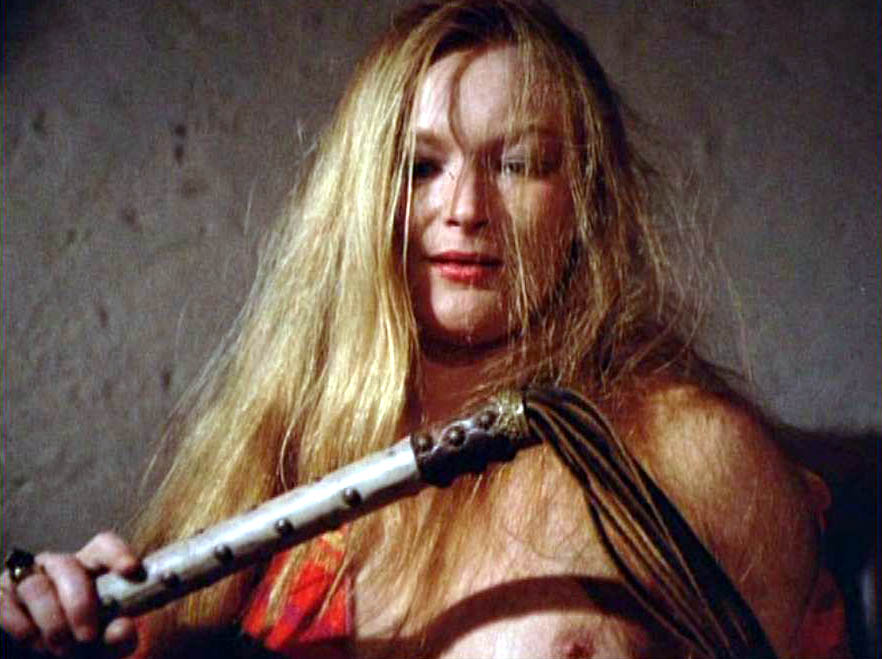
Thanks to Francesco Cesari for suggesting I might want to think twice.... Thanks to Eric Cotenas for helping me see the R2 German Kult DVD. Watch it in Spanish with English subs if you can get it. A German language track is also available. I wonder what my reaction will be to FLORES DE PASION?
(C) Robert Monell, 2020 (updated)05 January, 2021
AL OTRO LADO DEL ESPEJO (1973, Jesus Franco)

(a.k.a. THE OTHER SIDE OF THE MIRROR; LE MIRIOR OBSCÈNE; LO SPECCHIO
DEL PLACERE)
AL OTRO LADO DEL ESPEJO is the Spanish-language version of this twisted psychological thriller, which also exists
in a more explicit French-language version.
Though the production looks rushed and is somewhat incoherent, it is one of the busy director's most effective
and moving examinations of mental illness, as well as the possible connection between insanity and the world of
the occult.
Ana (Emma Cohen) is a musically talented but repressed woman who, though in her twenties, still lives with her
parents. The day Ana announces her engagement, her overprotective father (Howard Vernon) suddenly and inexplicably
commits suicide. Ana leaves home to forget the tragedy and finds companionship and work in a jazz band in Lisbon.
After awhile, she experiences disturbing visions of her father's death. Also, she hears his voice calling her from
a haunted mirror that appears in her room. Inside this strange mirror-world, she encounters several men trying
to win her affections. She brutally murders them at her dead father's command.
Coming back to reality, she attempts suicide but is saved at the last moment. Despite a therapeutic rest period,
her psychosis persist and she commits more murders. Finally, there is a deadly supernatural reckoning when the magic mirror is destroyed.

This unique addition to the Franco canon keeps the viewer emotionally engaged in Ana's tragedy, mostly due to Cohen's excellent performance. Thankfully, the film lacks the clinical, ultra-close-up quality that sometimes keeps the viewer at arm's-length in some of Franco's other thrillers.
Most fascinating is how Franco relates Ana's problem to religion, visually correlated by repeated shots of churches, religious statues, and evocative paintings. Ana's father is shown to be a devout Catholic who uses
faith to hide from his darker impulses. The plot's mystery is never really solved, but a final "vision" in the magical mirror suggests a possible explanation.
In addition, Franco populates the movie with a lot of Freudian imagery (cf. Hitchcock's SPELLBOUND), some of it bordering on the surreal: one almost subliminal image (in the French version) shows a goldfish transforming into a knife that Ana uses on one of her victim. The horrifying and repeated image of the father's corpse leads Ana again and again into the realm of madness and death. This same image also appears in Franco's VIRGIN AMONG THE LIVING DEAD, another study of a family tragedy.
Vernon is chilling in his role as the ambiguous father. Unfortunately, much of his performance is lost in the French version in favor of added erotic scenes featuring Lina Romay and Alice Arno.
The Spanish version also has a haunting music theme, which is replayed at different tempos, tracking the downward spiral of Ana's madness. The island of Madeira provided a breathtaking location for this nightmarish story, as it also did for THE BARE BREASTED COUNTESS, filmed
in the same year. Ana's personal mirror world, the reality on the other side of the mirror, is filled with both psychological and occult symbols. A fish out of water becomes a knife with which Ana will murder his current suitor. Jacques Lacan's theoretical STATE DU MIRIOR (Mirror Phase/State) comes to mind. Ana's father has a perhaps unconscious sexual obsession with his daughter, which is also glimpsed in the mirror phase. His spirit has seemed to have psychologically or supernaturally embedded itself in her subconscious, and it wants her to kill her lovers, which are competitors for the dead man's desperate, evil spirit. Or is it all due to Ana's disturbed emotional state, which is immersing her into violent fantasies?

The final image of Ana in her wedding gown brings up visual memory of the title character in Luis Bunuel's macabre 1961 dark satire VIRIDIANA in her bridal gown which she has put on to cater to the perverse desires of her hypocritical guardian. In the case of the Bunuel film the older guardian of the heroine also hangs himself when he is about to lose control of the object of desire. When I mentioned this to Jess Franco when I interviewed him he denied any direct influence, adding "he [Bunuel] was free; I was not." Which was technically true, Bunuel was given carte blanche by the Spanish censor and Francisco Franco government. It was only when they saw the finished film that they moved to withdraw and ban the film in Spain for years. Franco, who claimed to just be a director of a "commercial project" had no such guarantee.
Seen in it's uncut version, the film has a more focused emphasis on Ana's musical career and several sidebars featuring the more normal aspects of her daily life. This result in making her final fate more tragic.
al otro lado del espejo
1973 80 Minutes Q Video (Spain)/95 Minutes DVD (France). Director: Jesus Franco.
Cast: Emma Cohen, Howard Vernon, Robert Woods, Ramiro Oliveros, Waldemar Wohlfahrt,, Jess Franco, Philippe Lemaire, Franciose Brion, Alice Arno,Adela Tauler, Carmen Carbonnel< . Music: Adolfo Waitzman. Songs: Roger Sarbib. Produced by Robert De Nesle-CFFP-Paris, Jose Manuel Herero Producciones Orfeo S.A. Madrid. DP: Antonio Milan. Editor: Gerard Kikone, Mercedes Alonso. Asst. dir: Ana Maria Settimo de Esteva. Art dir: Luis Vasquez. Stills: Mario Lippert (Howard Vernon), Francesca Da Silva.
The additional cast in the French version: Lina Romay, Monique Delaunay, Roman Ardid.
Note: The Andre Benichou music for the French version is downbeat and largo tempo compared to the jaunty opening piano theme of the Spanish version. The Gerard Brissaud cinematography in the additional French scenes lacks the style and polish of the Spanish shot scenes. 
(C) Robert Monell 2021
23 December, 2020
JULIETTE DE SADE (Warren Kiefer, 1969) Jess Franco and Beyond.....

Vintage poster for the Italian release version of JULIETTE DE SADE
Recently I had a chance to finally see Warren Kiefer's obscure, shot-in-Italy feature film, JULIETTE DE SADE (1969).* Kiefer (1929-1995) was an American novelist, screenwriter and director who managed to make four largely forgotten films durin nog the 1960s. It's a modern take on the writings and philosophy of the Marquis de Sade which unfolds in 1969, in the midst of the era of peace, love, Woodstock, hippies, Manson and the emergence of an international counter culture. In cinema it was the era of breaking sexual boundaries, ultra-violence on the big screen (Sam Peckinpah's THE WILD BUNCH was also released in 1969), and exploring once forbidden subjects. JULIETTE DE SADE was not the only Sade film released in 1969. There was Jess Franco's big-budget (for him) JUSTINE AND JULIETTE, produced by Harry Alan Towers and American International's biopic, DE SADE, featuring Kier Dullea in the title role. The 1967 Peter Brook film of the play MARAT/SADE, in which Sade himself was a character putting on a historical drama, had already refreshed the memory of Sade in the pop culture of that decade. It was to be expected that exploitation products based on the works of Sade would follow.

Franco would release several more Sade adaptations in the 1970s, the best being EUGENIE DE SADE, starring the fated Soledad Miranda. EUGENIE, THE STORY OF HER JOURNEY INTO PERVERSION, based on Sade's novel PHILOSOPHY IN THE BOUDOIR, featuring Maire Liljedahl and Christopher Lee, opened in the U.S. in 1970. More Franco-directed Sade films would appear throughout the 1970s (PLAISIR A TROIS, SINFONIA EROTICA, COCKTAIL SPECIAL), into the 1980s (EUGENIE: HISTORIA DE UNA PERVERSION, GEMIDOS DE PLACER), and his 21st Century digital period (HELTER SKELTER, 2000).

Above: Body painting in JULIETTE DE SADE.

Sade's 1798 1000 plus page epic is a companion to, and second part of LE NOUVELLE JUSTINE, OUR LES MALHEURES DE LA VERTU (1797). It's a first person, episodic narrative, in which Juliette travels the world, getting educated in :he Sadean philosophy as she participates in a cornucopia of sexual perversions. At the end, she announces, "...the truth itself, and the truth alone, lays bare the secrets of Nature, however mankind may tremble before those revelations. Philosophy must never shrink from speaking out." And speak out it continuously does in six long, detailed sections. The most surprising element of Kiefer's film is that it ends with a refutation by the heroine of Sade's philosophy as she flies away to a far more conventional lifestyle and mindset.

Opening with Juliette (Maria Pia Conte) attending body painting sessions, orgies, sexy dancing parties, we're immersed in La Dolce Vita, Rome 1969 style. She finally meets a distinguished looking expert of the philosophy of Sade. Played by familiar Euro-genre character actor John Karlsen, a gaunt, elderly looking actor who appeared as authority figures, villains, and professional types like the doctor who ran the insane asylum for women in Fernando Di Leo's Italian slasher SLAUGHTER HOTEL (1971). Karlsen looks like he's in his 80s here, even with a very 1969 Fu Manchu mustache. The actor would go on to appear in dozens of other Rome based European Cult/Trash cinema genre films and sometimes mainstream Hollywood titles like BILL AND TED'S EXCELLENT ADVENTURE.
The Sade enthusiast hosts a dinner in which one of Juliette's friends does an enticing erotic dance in close contact with a miniature of Michelangelo's "David." This is the most erotic scene in the film, and despite it being supposedly based on a Sade novel, contains no scenes of sadomasochistic violence. It's more like Franco's VENUS IN FURS, the title of which suggests a famous book which explored masochism. another 1969 release, which did contain scenes of whipping, torture and had a much darker tone and an appropriately ambiguous ending.
Juliette's Sadean instructor even gifts her with an ultra sleek, high ticket Lamborghini, in which she speeds around from one Roman hot spots to another until a bad Roger Corman-like LSD trip (in a museum!) results in a change of consciousness . Suddenly aware of the superficiality of her lifestyle, represented by her throwing the keys to the Lamborghini back to her guru, her rejection of both him and the philosophy of The Divine Marquis seems complete and permanent. But, you never know. This was still the 1960s, albeit on the cusp of the more unpredictable 1970s. The feeling of wanting more thematic exposition is the film's main problem. Perhaps a more visual/ironic representation of the perversions and contradictions illustrated in the writings of Sade would have been appropriate. One wonders if censorship were an issue. The print consulted for this review was more than 10 minutes shorter than the original runtime.
 b
b
Even Roger Greenspun's review in The New York Times, published December 27, 1969**(see below), complains that the heroine is never allowed to completely disrobe on camera. You know you're in trouble when The New York Times is suggesting more nudity was necessary for authenticity. Greenspun makes some good points in the review, but I find it overly dismissive and has an annoyingly superior tone. Flaws and all, JULIETTE DE SADE is a rarely seen oddity, worth seeing over 50 years after it was made. Kiefer was a talented novelist and an interesting, if under-productive, filmmaker. His Italian-shot horror film, CASTLE OF THE LIVING DEAD (1964), is a macabre, atmospheric, Gothic period piece. That film featured Christopher Lee as a castle bound aristocrat with a morbid obsession with the science of embalming. An actor with the agency of Lee would have provided needed grounding and authorial presence in JULIETTE DE SADE, rather than a voice-over. Nonetheless, this film deserves to be rediscovered, restored to its full length English language version and given an HD debut.
Here's a link to Robert Curti's excellent article on the writing and film career of Warren Kiefer. https://offscreen.com/view/warren_kiefer
*Thanks to Jeremy Richey for helping me see this film.
** THE NEW YORK TIMES review of EUGENIE DE SADE, which opened in New York City on December 26th, 1969.
REVIEW by Roger Greenspun. Dec. 27, 1969. "For perhaps two minutes, at the beginning and again at the very end, "Juliette de Sade," now playing at the Rialto East and the Rialto West, succeeds as erotic movie making. In those minutes we are offered close-ups of the star's thighs, her lips, a poised cigarette, her invitational eyes—put together in slow, straightforward montage as a kind of monumental tease. Such moments of colossal intimacy, of passionate secrets shared with a movie screen, are of course their own reward. But in "Juliette de Sade" they are too meager and too few to validate the film.For the 81 intervening minutes, the same young lady, Maria Pia Conte, offers us almost nothing at all. This is the first time I have seen a movie with pretensions to pornography in which the principal actress never disrobes for the audience.
Because she leads a life of willing sin and dissolution, she is continually in situations (bed, for example) where she ought to be undressed. But she never visibly is, and the resulting calisthenics devoted to holding the sheets up under the chin or keeping the beach towel from falling off would have done credit to, say, the athletic purity of Doris Day in her most embattled moments.Based, according to the distributor, on Sade's "Juliette," the film concerns a precocious young thing who leaves her convent school quickly behind and comes to conquer mad, mod, swinging Rome. She finds a roommate, buys a lot of new clothes and meets an evil old man with a walrus mustache. He declares himself a follower of the divine Marquis de Sade, a name that from, the pleasure principles the old man elaborates, might as well be a pseudonym for Jeremy Bentham. He promises to instruct Juliette in his "philosophy." Connoisseurs of the genre will recognize that "philosophy" is always a dirty word when muttered in the presence of a leggy blonde, but in this film it might as well be a system of Kantian imperatives for all the bad that comes from it.So the old man gives her a new car, has her over to dinner with some friends and plays a game of chess with her. For a time she accepts this corruption. ("I had Rome where I wanted it, in the palm of my hand. And I wasn't going to let go until I had squeezed it dry," exults Juliette's voice, English-dubbed, while her yellow-green Lamborghini P400 zips past St. Peter's.)
And it is here, on the beaches and in the middle-class apartments of Rome, that the film's imaginative poverty (not depravity) shows itself to worst effect."Juliette de Sade" means to suggest a sensualism of rich ornamentation and of plastic surfaces. Like most movies of its type, the film pretends to private knowledge in addition to sex, and to forbidden mysteries beyond the body.But, unlike most movies of its type, it supports those pretenses with fairly classy production values and handsome photography. It falls victim to its own aspirations, and to a tone of prissy elegance. Typically, Miss Conte, though she never strips, does indulge in a singularly unexciting fashion show.Before she breaks away from her sponsor—to set up in business for herself—Juliette suffers an LSD trip and an orgy. Nothing in the trip (the worst in a miserable tradition) deserves description. But during the orgy, which consists of two men and three women eating grapes, etc., Juliette's roommate does an erotic dance around, over and up against a pint-sized reproduction of Michelangelo's "David." The scene is supposed to be tense with energy and illusion, but the girl slithers without conviction, and the little David, a model of outmoded decorum, hides his plaster with a fig leaf.
The Cast: Juliette . . . . . Maria Pia Conte Toni . . . . . Lea Nanni Clarissa . . . . . Christine . . . . . Angela de Leo. JULIETTE DE SADE, directed by Warren Kiefer; produced by Ninki Masiansky; released by Haven International Pictures. At the Rialto East, Broadway near 42d Street, and the Rialto West, 42d Street west of Broadway. Running time: 83 minutes. (Not submitted at this time to the Motion Picture Association of America's Production Code and Rating Administration for rating as to audience suitability.)
(C) Robert Monell, 2020
13 December, 2020
LA ESCLAVA BLANCA (Clifford Brown/Jess Franco. 1985)
la esclava blanca, 1985- source: Video Search of Miami (Spanish VHS-U.S. import) DIRECTED BY "CLIFFORD BROWN" (JESS FRANCO) WITH: JOSÉ LLAMAS, MABEL ESCAÑO, JOSE MIGUEL GARCIA MARFA, AUGUSTÎN GIL, LINA ROMAY, CONCHI MONTÉSa, JAMES TALL. 87 minutes

Of the eight other films Franco made in 1985 (half of them hardcore porno features), this very low budget adventure stands out because of an absorbing, multi-layered script by ace Spanish screenwriter Santiago Moncada. Beside writing Mario Bava's HATCHET FOR THE HONEYMOON, Claudio Guerin Hill's THE BELL FROM HELL and Juan Antonio Bardem's THE CORRUPTION OF CHRIS MILLER, Moncada has written and produced screenplays for a variety of European genre directors. Manuel Cano's SWAMP OF THE RAVENS, TARZAN'S GREATEST CHALLENGE and VOODOO BLACK EXORCIST were all based on Moncada screenplays, not to mention the ultra-violent Spanish western CUTTHROATS NINE. This film was co-produced by Moncada and Franco's Manacoa company.

.As for Jess Franco, 1985 wasn't his best year, but it was a busy one, offering a variate of micro-budgeted genre projects. In LA ESCLAVA BLANCA, Moncada gives us three separate stories that gradually interweave and come together in the final scene. The first story seems to have elements of MACBETH and B movie programmers. A weak-willed jungle guide is manipulated by his domineering wife into committing a series of crimes. During a safari, he leads a honeymoon couple (José Llamas and Conchi Montés) into a trap laid by the Tobonga, a Stone Age tribe that worships a giant lizard god. The bride is tied to a sacrificial altar for later sacrifice. The second story starts out in the city, where a female karate student (Lina Romay and two of her instructors accidentally discover the secret of the Tobonga. In the third story, two separate expeditions make their way back to the Tobonga camp. One of these groups includes the original guide, who has been abducted by the karate instructors (they have also killed his wife). The other consists of the husband of the abducted woman and the female karate student (Lina Romay) who has split off from the school. During the long trip back, the guide has a change of heart and decides to repent, turning against his captors and helping the people he originally betrayed.
The climax of the film, shot and edited with dispatch despite the budgetary restrictions, may remind some viewers of a miniature version of the final scene in THE WILD BUNCH. The very last scene, in which the Tobonga gold is abandoned by the survivors, echoes THE TREASURE OF SIERRA MADRE. Franco's film, of course, is a lot less ambitious than those two classics, but maybe that's why it works so well. The massacre at the Tobonga camp, the abduction scene, and the opening safari are as well-staged as anything Franco has ever done. There's also an amusing dose of voodoo dancing thrown in for good measure. He takes it all seriously, even though it's bascially juvenile comic-strip pulp. But, then again, Jess Franco had a life long passion for comics and pulp fiction.
Daniel White's pulsating drum and vocal score is familiar from some of Franco's other jungle adventures (MACUMBA SEXUAL, DEVIL HUNTER), but this is by the most unpretentious of the lot. Jose Miguel Marfa and Mabel Escaño are both very effective as the safari guides from hell. With its karate scenes, voodoo rituals, adventure story, literary and film references, LA ESCLAVA BLANCA seems like a kind of compendium of Franco's 1980's output (minus the XXX sex material). I
If one can get past his other sub-standard jungle/cannibal fare, this one is most definitely provides 90 minutes of undemanding entertainment. I would be pleasantly surpised if this fogotten mid 1980s programmer showed up on a Bllu-ray release, but stranger things have happened. I I had some behind the scenes photos of the shoot supplied by Senor Marfa but haven't yet been able to transfer them here. The Spanish locations will be very familiar to seripusJess Franco collectors.
(C) Robert Monell Updated 2020
09 November, 2020
LOS BLUES DE LA CALLE POP (Jesus Franco, 1983)




03 September, 2020
BANGKOK, CITA CON LA MUERTE (1985, Directed by Clifford Brown [Jess Franco])
Robert Monell & Alex Mendíbil Blog Alliance
BANGKOK, CITA CON LA MUERTE (Clifford Brown, 1985)
BANGKOK, CITA CON LA MUERTE is fascinating to the serious Jess Franco student but may not
engage interest as a serious action film with Jess Franco-style martial
arts interludes included. The formulaic plot combines drug running,
Thai pirates (led by Lina Romay), karate fighting, kidnapping, comic
relief and tourist footage which on first viewing looks cribbed from an
unknown source.* [Update: the DoP of this film, Juan Soler Cozar, read
this review and kindly informed me that he was actually sent to Bangkok
to shoot some street footage, and that it does appear in the film. I was
very surprised that they went to the expense and trouble to do this,
especially considering the production’s obvious micro-budget.]

The yacht-going daughter of a millionaire is kidnapped by pirates. Her
father (Eduardo Fajardo) hires a bumbling private eye named Panama Joe
(Bork Gordon) to locate her. The daughter’s boyfriend is also on the
kidnappers’ trail. Panama Joe discovers the crooks are led by a drug
smuggler (Antonio Mayans), who is in turn being double crossed by Queen
Amania (Lina Romay). The detective roams around the faux Asian
locations, tries to play both sides against the other, while uncovering
deeper layers of corruption and double dealing.BANGKOK is dialogue and
plot heavy to no good end, and Gordon’s imitation Inspector Columbo
ramblings just do not spark enough interest. The characters are shown
talking in cartoon dialog balloons during the opening credits, but
Franco unaccountably drops this unusual device immediately and never
picks it up again. What’s left is a C-minus adventure with some comic relief and sloppily staged karate stand-offs, in which
the participants miss each other by miles. Then again, given the budget and assumed rushed shooting schedule this could be understandable. It also could indicate the director's disdain for those perfectly choreographed martial arts films of Chuck Norris, Jackie Chan, Sonny Chiba, etc.
Gordon (Christian Borck) just seems a disheveled guy, actually a German comedian/television actor, who wandered in. Like the karate stuff, comedy-parody needs timing. The lines and martial arts blows rarely connect. Actually, I managed to find some amusement in the martial arts showdowns where the fighters miss contact with each other by such obvious distances that it looks like children playing at karate fighting. This is all likely due to a crushing schedule/lack of budget. Nonetheless the colorful cinematography frames the locations with skill and makes the Canary Islands seem like Southeast Asia, at least for 90 minutes.
BANGKOK, APPOINTMENT WITH DEATH (VSOM dupe from Spanish television broadcast)
|
|
A colorful, amusing mix of Kung Fu fighting, Asian aesthetics,
modern day pirates, BANGKOK CITY OF THE DEAD (1985) mixes comic
book-style imagery with crime film elements, some self parody and a
adventure plot with a not-so-happy ending. Franco has tried this before,
notably in the delightful LOS BLUES CALLE POP…. (1983) and La sombra
del judoka contra el doctor Wong (1985).
Lina Romay has a few touching moments as the pirate leader, but she is once again miscast, and her familiarity as Lina Romay distracts from her performance. In one embarrassing scene, shes dances around in a tight swimsuit accompanied by a mechanical band. The result might been cute in 1973, but at this late date it is unfunny and unflattering to the talented Ms. Romay. Veteran character actor Fajardo (DJANGO) turns in a professional but unexceptional performance as the millionaire. The movie benefits from its luminous cinematography and occasionally hectic energy but needs a more interesting focal point.. The Far Eastern locations, represented via the aforementioned stock footage are given an atmospheric boost by Pablo Villa’s (Franco and Daniel White) brassy score, some of which recalls music heard in Franco’s earlier FU MANCHU AND THE KISS OF DEATH/KISS AND KILL (1967). Given the negatives I’m at the stage where I can still engage with and enjoy even an understandably flawed genre mashup such as this one. It’s obvious that Jess Franco took it serious enough to attempt to deliver a multi-faced entertainment package under impossible circumstances. As he told me when I interviewed him on his Golden Films Internacional period, these productions were “poor” i.e. made at very low coast, with little or no resources and rushed out to theaters or hidden away in the offices of producer Emilio Larraga to be lost forever. I had some fun watching it but have no idea where one could see it outside of fan websites. I am not aware of any DVD release, although it may have appeared on Spanish VHS. The version I saw was from the wretchedly unreliable VSOM and had no English subtitles. A good quality HD transfer from a print or negative with language options is required for a more in-depth consideration, but it’s an example of Franco’s 1980s exotica. *Thanks again to Juan Cozar for additional information on the production of this film. |
 (C) Robert Monell [1998: New Version: 2020
| Bangkok, Cita con la Muerte 1985; 87 Minutes; Spanish TV broadcast Director: “Clifford Brawm” sic (Jess Franco)/ Director of Photography: Juan Cozar./ Produced by Golden Films Internacional S.A. in Alicante and Bangkok, Thailand. |
Subscribe to:
Posts (Atom)